

SAP’s New AI Strategy: Will ERP Become the Autonomous Control Center of the Enterprise?

Chapters
Share Article
Let's Talk SAP Security
Have questions about SAP Security? We’re here to help. Contact Us
A CEO perspective on SAP Business AI, autonomous enterprises, and the new SAP security reality.
At SAP Sapphire 2026 in Orlando, Christian Klein offered a clear view into SAP’s strategic direction: the future of enterprise software is not just cloud-based, data-driven, or AI-assisted. It is becoming autonomous.
SAP introduced its vision of the “Autonomous Enterprise” — a model where enterprise AI agents, trusted business data, process logic, and enterprise governance come together to execute business processes faster and with less manual intervention. SAP describes this as a model where humans and AI work together across critical business workflows, supported by SAP Business AI Platform, SAP Business Data Cloud, Joule, SAP Knowledge Graph, and SAP Domain Models.
For decades, ERP was the system of record — it documented what happened in the enterprise. Later it became the system of process execution, helping to standardize and scale operations. SAP is now positioning ERP as something more ambitious: the intelligent orchestration layer for the autonomous enterprise.
In my view, this is one of the most customer-centric moves SAP has made in years.
The “One-Person Unicorn” Vision Meets Enterprise Reality
Such a company would need more than a chatbot. It would need AI that can interact with software systems, understand financial logic, execute supply chain tasks, manage customer operations, trigger procurement, and coordinate decisions across the enterprise.
This is where SAP’s strategy becomes relevant. If a future company is largely run by AI agents, the ERP system will likely remain the system of record for the most important business processes. Finance, procurement, supply chain, HR, manufacturing, customer operations — all of these depend on structured processes, reliable data, and enforceable business rules. SAP’s move is therefore not simply about adding AI features for AI.
Why Joule, Business Data Cloud, and Knowledge Graph Matter
The real value of AI in the enterprise will not come from generic language models alone. They do not automatically understand how a company works. They do not know which data is relevant, which process step comes next, which approval is mandatory, or which action would violate internal policy.
SAP Business Data Cloud provides the data foundation for both SAP and non-SAP data, while SAP Knowledge Graph gives AI agents a structured view of business entities, their relationships, and the processes that connect them. SAP Domain Models are designed to help AI reason over business-specific context rather than generic information. SAP has described these models as being trained on SAP code, customer data, metadata, and business processes to give Joule Agents a richer understanding of enterprise logic.
For anyone who has ever taken their first steps inside SAP ERP, this is a fascinating development. When I started out with SAP years ago, I would have wished for exactly this kind of resource: a readable explanation of the data model, the business logic behind it, and how objects, transactions, and processes actually relate to each other.
If AI agents can tap into this structured knowledge, they can interpret enterprise data far more accurately — and, more importantly, perform guided actions while respecting business logic, compliance rules, and governance requirements.
That is what separates AI as a productivity tool from AI as a real enterprise execution layer.
SAP’s Strategic Opportunity
The bigger question is whether SAP can actively shape the AI era rather than just participate in it.
I believe it can.
SAP owns something most AI companies do not: decades of enterprise process knowledge. It understands how global enterprises actually run — financial closing, procurement, logistics, manufacturing, asset management, HR, and cross-border compliance. SAP also knows that “almost right” is not good enough in mission-critical processes, a point Christian Klein emphasized in Orlando.
That is SAP’s strategic advantage.
The AI era will not replace enterprise process logic; it will increase the demand for it. The more autonomous software becomes, the more critical it is that its actions are grounded in trusted data, governed processes, clear authorization models, and audit trails.
If SAP pulls this off, it will not only defend its position as the global ERP market leader — it could become one of the most important platforms for enterprise AI execution.
Autonomy Creates a New Security Reality
As a cybersecurity company focused on SAP, we at SecurityBridge tend to ask a different question:
What are the security implications when AI agents begin to execute business processes inside ERP systems?
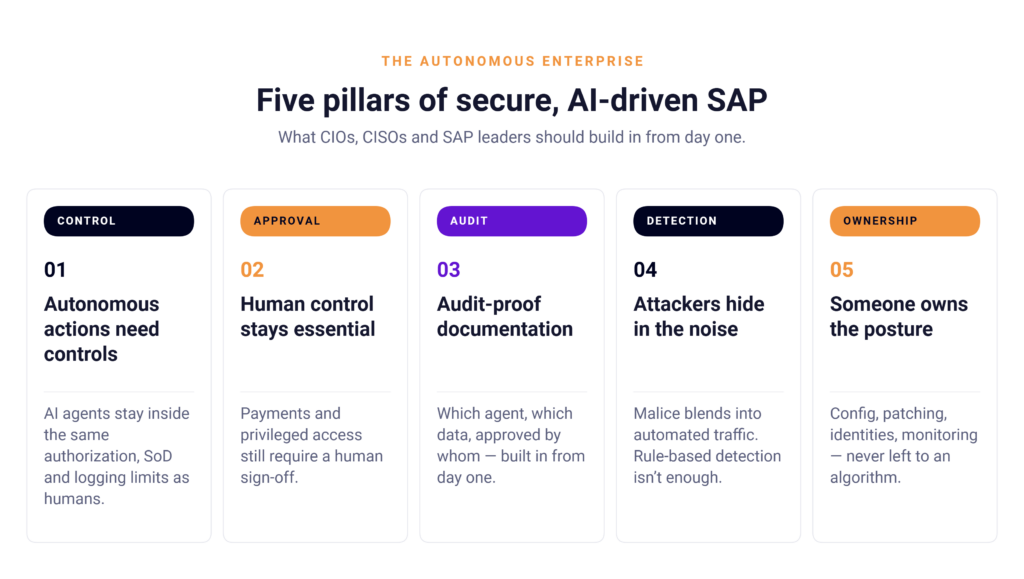
I have discussed this with colleagues in our Security Research Lab, and we have come up with several theses that CIOs, CISOs, and SAP leaders should already be thinking about today.
The autonomous enterprise may still sound futuristic, but the attack vectors are not. They are extensions of risks we already know — only faster, more automated, and harder to detect.
1. Autonomous Actions Require Security Controls
If AI agents execute business processes, they must operate within the same security and compliance boundaries as human users.
That means:
• Clear authorization models
• Strong identity and access management
• Segregation of duties
• Process-level controls
• Logging of every autonomous action
• Transparent decision paths
• Continuous monitoring
An AI agent should not become a superuser by design, and it should not bypass approval rules simply because it can finish a task faster. If anything, the opposite applies: the more autonomous an agent becomes, the stricter its control framework needs to be. Every action must be attributable, every decision explainable, and every exception visible.
2. Human Control Remains Necessary
The future will not be built on blind trust — it will be built on controlled trust.
AI will deliver enormous efficiency gains, but it will also make mistakes. Agents can misread instructions, act on incomplete context, or be manipulated through newer attack techniques such as prompt injection, poisoned training data, or compromised integrations.
For critical business processes, human approval will remain essential.
Examples include:
• Payment approvals
• Vendor master data changes
• Privileged access requests
• Release of sensitive financial data
• Changes to security-relevant configuration
• Material business decisions affecting customers, employees, or regulators
The real question is not whether humans stay involved, but where human control is most valuable.
Companies should map out the neuralgic points in their SAP processes where human validation must remain mandatory. AI can prepare, recommend, simulate, and even execute — but the final call in high-risk scenarios should still sit with a human.
3. Audit-Proof Documentation Becomes Critical
The more an organization relies on autonomous recommendations, the more important audit-proof documentation becomes.
In traditional ERP environments, companies already struggle with documentation, change tracking, and evidence collection. In an AI-driven environment, that challenge grows by another order of magnitude.
Auditors will want to know:
• Which AI agent performed an action?
• Which data did the agent use?
• Which model or workflow generated the recommendation?
• Which human approved the action?
• Was the action compliant with company policy?
• Was the decision reproducible and explainable?
• Were exceptions documented?
Without reliable documentation, companies risk regulatory violations, legal exposure, and loss of trust.
Autonomous business execution must therefore be designed with auditability from day one. Documentation cannot be an afterthought it has to be embedded into the process architecture itself.
4. Attackers May Hide in the Noise of AI Activity
One of the most important security questions is this:
What happens if an attacker is already inside the system while AI agents are generating thousands of legitimate actions?
In a highly automated ERP environment, the sheer volume of system activity will rise. AI agents may create purchase orders, update master data, trigger workflows, reconcile accounts, generate reports, and talk to other systems.
All of this creates noise and noise is useful for attackers.
Malicious activity becomes much harder to spot when it blends into legitimate autonomous process execution. A fraudulent payment, an unauthorized role assignment, a suspicious configuration change, or a manipulated business object can easily look like just another automated transaction.
Security monitoring will therefore have to evolve.
Traditional rule-based detection alone is not going to cut it. SAP security teams will need behavioral monitoring, anomaly detection, process-aware threat detection, and continuous validation of system integrity.
In an autonomous enterprise, the question is no longer just “Who did what?” but also “Was this action expected, justified, authorized, and consistent with normal business behavior?”
5. Who Owns the Security Posture?
Autonomous process execution is not the same as secure process execution.
Even if AI manages workflows brilliantly, companies still need to protect the underlying ERP landscape — data models, business logic, identities, interfaces, and custom code.
Important questions remain:
• Are SAP systems securely configured?
• Are critical vulnerabilities patched?
• Are users and roles properly maintained?
• Are emergency accesses monitored?
• Are interfaces protected?
• Are custom developments secure?
• Are business-critical changes reviewed?
• Are security events detected in real time?
AI can help with parts of this, but accountability cannot be delegated to an algorithm.
CIOs, CISOs, and SAP leaders need a clear operating model for SAP security — with visibility into their posture, automated controls, continuous monitoring, and clear ownership.
This becomes even more important when AI agents begin to interact with the most sensitive business processes in the company.
The Autonomous Enterprise Needs Autonomous Security — But Not Uncontrolled Security
SAP’s AI strategy is a logical and powerful step forward, and it reflects where the enterprise market is clearly heading. Companies want productivity gains, faster execution, better decision-making, and more automation — and SAP is right to anchor AI in trusted data, process knowledge, and enterprise governance.
But the more autonomous the enterprise becomes, the more security has to be built into its foundation.
Security cannot be bolted onto an autonomous enterprise after the fact — it has to be part of the design.
For CIOs, CISOs, and SAP leaders, this means the AI conversation cannot be separated from the SAP security conversation.
Every AI strategy should include:
• Identity and access control for AI agents
• Segregation of duties for autonomous actions
• Human approval for high-risk processes
• Audit-proof documentation
• Continuous SAP threat monitoring
• Vulnerability and patch management
• Secure configuration management
• Clear ownership of SAP security posture
The future of ERP may well be autonomous. But autonomy without control isn’t innovation — it is risk at scale.
Final Thought
If we ever do see a unicorn company run by a single person, there is a good chance that SAP will be orchestrating many of the core business processes behind the scenes.
That is a fascinating vision.
But for the vision to become enterprise reality, trust will be the decisive factor — not only trust in AI itself, but trust in the data, the process logic, the controls, the audit trail, and the assurance that the most critical business systems are protected against misuse, manipulation, and attack.
SAP’s new AI strategy points in the right direction. It is now up to the enterprise world to make sure the autonomous enterprise turns out to be not only intelligent and efficient, but also secure.
Sources Consulted
• https://news.sap.com/2026/05/sap-sapphire-keynote-business-ai-platform-power-autonomous-enterprise/
• https://news.sap.com/2026/05/future-enterprise-autonomous/