



For years, SAP security conversations have started in the wrong place – with tools, integrations, control coverage, and visibility sources.
But the real question comes before tools:
Will you secure SAP from the inside, where attacks actually occur – or from the outside, where behavior can only be approximated?
This single architectural choice determines how much risk you can see, how quickly you can respond, and how effectively you can protect business-critical systems.
Most organizations discover this the hard way. They move through predictable stages of visibility before realizing that external architectures can monitor SAP – but only internal architectures can secure it.
Let’s walk through that journey.
Stage 1 – The Infrastructure Illusion (Limited Visibility)
Many SAP teams begin with the assumption that infrastructure monitoring “covers” SAP.
It doesn’t.
Infrastructure tools watch host performance, network flows, CPU usage, and OS-level logs. All of that is useful – but none of it touches the SAP logic layer, where:
- Business logic decides outcomes
- Sensitive operations occur
Infrastructure visibility is valuable.
But it’s not SAP security.
Stage 2 – External Tools and Observability (Adjacent Visibility)
To extend visibility, organizations add SIEM connectors, observability platforms, PowerConnect-style collectors, Solution Manager, Focused Run, LogServ, SAP Raven, or Cloud ALM.
These tools provide operational awareness:
- Performance trends and anomalies
- Illuminate patterns
- Cross-system signals
- Workload behavior
- Enrich SIEM pipelines
But they remain outside SAP’s security decision-making layer.
They can show activity around SAP.
They cannot show how SAP itself interprets that activity.
This is a critical distinction – and the point where many organizations mistakenly equate “more data” with “more security.”
Stage 3 – The False Confidence Plateau
Dashboards turn green. Network traffic looks normal. CPU is stable.
And it feels like SAP is secure.
But these metrics measure the health of the environment – not the safety of SAP’s logic layer.
This is the moment when adjacent visibility stops being enough.
External tools help, but they cannot reveal:
- How ABAP executes
- How privileges resolve
- How transports changed the security posture
- Or how SAP interpreted a sensitive operation deep in its logic
They see symptoms of behavior, not the intent behind it.
One view captures noise; the other captures intent.
This is the moment many teams realize they’re missing the critical signals – the ones that determine whether SAP is being misused, exploited, or manipulated. The visibility questions end, and architectural choices begin
And this leads to the real debate.
Stage 4 – The Architecture Debate: Internal vs. External Execution
Once organizations understand the visibility gap, the question shifts from visibility to architecture, and this is where the difference becomes unambiguous.
This isn’t a vendor contest. It’s the architectural reasoning sequence that teams work through to understand what each design choice enables, restricts, or complicates.
Answering these questions usually resolves the architecture debate on its own.
Can your SAP cybersecurity solution reach SAP-layer telemetry?
Most meaningful security-relevant signals originate within SAP: ABAP runtime behavior, inbound-request evaluation paths, execution traces, privilege evaluation sequences, HANA traces, and change document histories.
External tools can ingest SAP logs and configuration via RFC, APIs, or connectors.
This provides reach, but not context, and is only half the required architecture.
A Necessary Nuance: External Tools with Deep Internal Reach
These designs still require exporting vulnerability findings, posture data, and events into an external runtime with its own dependencies and trust model. Sensitive content crosses trust boundaries and lands in environments SAP does not govern.
This produces a blended architecture:
Deep internal reach + external processing across multiple runtimes.
Capable, yes – but distinct from SAP-internal execution, where analysis occurs at the point the signals originate.
An additional layer to this reach comes with action: external architectures cannot act directly within SAP in real-time, whereas internal ones can block cyberattacks or malicious activity as it occurs, for example, by enforcing step-up authentication when threat actors attempt high-privilege actions.
These signals were designed to be interpreted inside SAP, where the logic lives. The closer you are to the source, the more accurately you can detect misuse or insider threats.
Real-Time Action: Can our SAP security stack prevent threats?
External tools analyze data after it’s exported from SAP.
Internal tools act during the event.
This enables capabilities that external architectures can never achieve:
- Blocking malicious ABAP calls
- Enforcing MFA for high-risk actions
- Preventing privilege escalation during runtime
- Detecting suspicious identity context in real time
- Correlating code execution with business logic intent
This is not a feature comparison.
It is a fundamental architectural limit of external systems.
What additional attack surface and overhead does the architecture add?
External architectures require:
- Additional servers
- Runtimes and libraries
- Open-source components
- External storage
- Multiple advisory streams
- Cross-system credential trust
Every component increases your attack surface and is an ongoing operational overhead – not one-time decisions.
Internal SAP architectures stay within SAP’s governed lifecycle.
No external runtimes.
No parallel patching.
No expanding dependency tree.
Simpler architecture = lower risk.
Does this solution align with SAP’s lifecycle?
SAP movement – transports, Security Notes, Dev→QA→Prod promotion, HANA updates – follow a defined cadence. SAP-internal architectures move with it.
External architectures must re-establish trust, revalidate connectivity, and re-synchronize posture each time SAP evolves.
Internal architectures inherit all of this automatically, because they live where SAP lives.
Less friction.
Less operational overhead.
Significantly lower total cost of ownership.
What does Total Cost of Ownership (TCO) look like?
Externally hosted architectures introduce additional cost layers: hosting, maintenance, external stack patching, trust-element administration, and cross-team coordination.
These accumulate annually.
A Practical Example: Privilege Misuse
Imagine a user attempting a privilege escalation.
An external observability tool sees:
- An odd call sequence
- An unusual pattern in network or system behavior
It can flag an anomaly – but it cannot explain it.
SAP-internal security sees:
- Which roles were evaluated
- Which function modules were engaged
- How the system interpreted the action
One view captures noise.
The other captures intent.
That is the power of proximity.
SAP Is Evolving – And that Changes the Debate
As organizations shift to S/4HANA, hybrid identity, BTP, and RISE architectures, SAP is becoming more distributed – but the logic layer remains the system of record for business-critical decisions.
This strengthens the case for internal security:
- No data movement across trust lines
- No additional systems to maintain
- Real-time evaluation exactly where logic executes
- Lifecycle alignment with SAP’s own updates
External architectures must chase SAP’s evolution.
Internal architectures inherit it.
Practical Recommendations for SAP Security Leaders
If your visibility is still limited to infrastructure or “adjacent” observability layers:
- Move your focus into the SAP application layer – where risk resides
- Treat external tools as observability, not cybersecurity
- Evaluate the operational cost and trust boundaries you’re adding
- Prioritize architectures that act in real time, not after the fact
This is where strategy becomes architecture – and where architecture becomes security.
Conclusion: SAP Security Belongs Inside SAP
Doing nothing leaves blind spots.
Adjacent visibility helps, but cannot replace SAP-internal visibility.
External deep-reach designs are capable but depend on external runtimes and trust boundaries. They expand the attack surface and create continuous operational overhead.
Internal SAP security architectures:
- Align with SAP’s lifecycle
- Evaluate risk when it occurs
- Minimize trust boundaries and complexity
- Adds additional layers of security, instead of additional layers of risk
- Deliver the deepest and most accurate visibility
This is why the industry is shifting decisively toward SAP-internal execution.
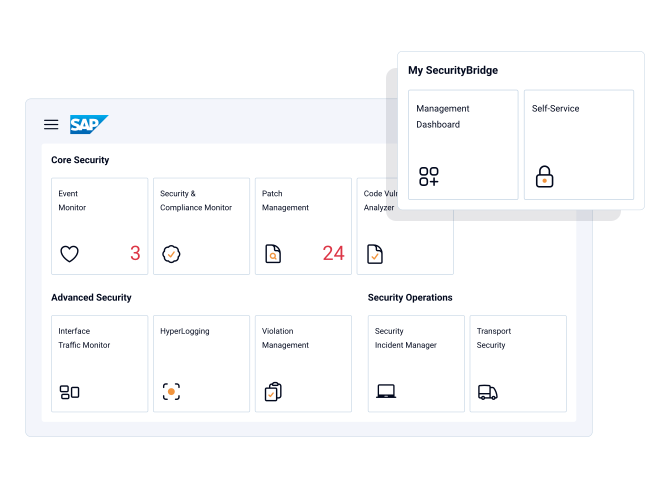
SecurityBridge is built inside SAP, for SAP, by SAP experts – delivering native protection where SAP logic actually runs.
If SAP powers your enterprise, your SAP cybersecurity architecture should live there too.
About the author:
 Barry Snow has been working in the corporate IT industry since 1996, and has focused his IT career on SAP in 2006. His top SAP passions are Master Data, Cybersecurity, and Training. Barry has broad cross-module exposure in both SAP Security and the SAP Data Mgmt disciplines. In the past 7 years, he has consulted globally on over 35 implementations of SAP Security solutions.
He is a regular content creator in the SAP Community on LinkedIn and a Pre-Sales Solution Engineer and Technical Account Manager at SecurityBridge.